

In accordance with the student research plan for the 2025 - 2026 academic year, the Faculty of Agriculture and Aquaculture at Bac Lieu University held a presentation and final evaluation of the research project conducted by Nguyễn Gia Khiêm, a student of Class 16DBVTV in the Plant Protection program. The Evaluation Committee was chaired by Dr. Mai Như Phương, with M.Sc. Phạm Thị Thắm and M.Sc. Nguyễn Thị Thúy Hằng as committee members.
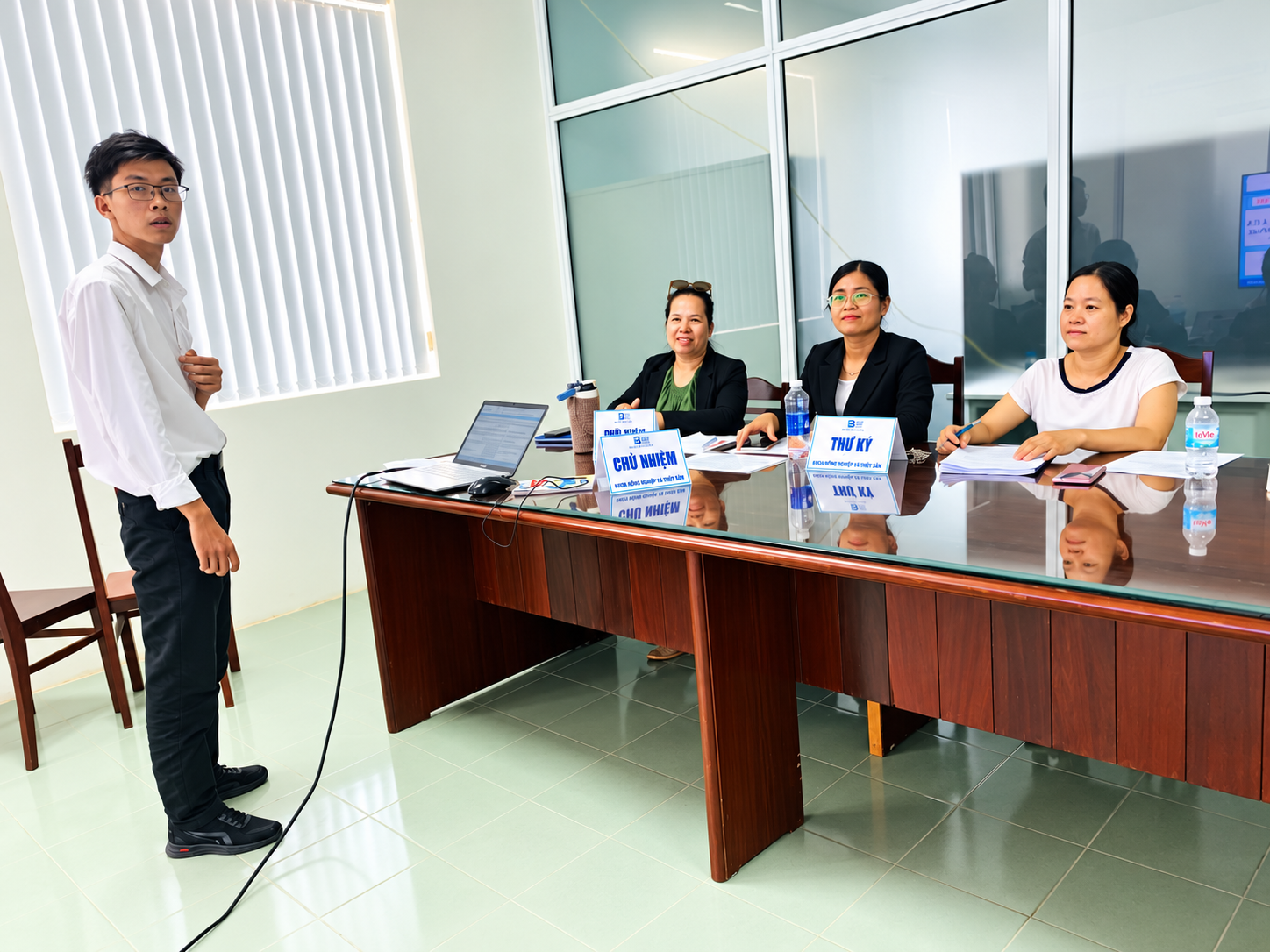
The Evaluation Committee assessed Nguyễn Gia Khiêm's student research project
The project, entitled “Studying the progression and severity of pest and disease infestations in a high-tech rice production model adapted to climate change in Hòa Bình Commune, Cà Mau Province”, was conducted under the supervision of Dr. Nguyễn Văn Bo. It focused on surveying the composition, seasonal dynamics, and damage levels of major rice pests and diseases, while also monitoring the occurrence of natural enemies in a high-technology production model compared with conventional farming practices.
As climate change increasingly affects agricultural production in Cà Mau Province and the Mekong Delta, applying scientific and technological advances to reduce input costs, improve pest management, and increase rice yields has become particularly important. Therefore, the project was performed to provide scientific evidence and practical information for refining safe, sustainable, high-quality rice cultivation practices suited to local production conditions and climate change adaptation.
The study was conducted during the 2025 - 2026 Winter-Spring rice crop in Hòa Bình Commune, Cà Mau Province, across a total area of 5 ha, comprising 2.5 ha under the high-technology model and 2.5 ha under the control treatment. The model used the ST25 rice variety and incorporated row seeding at a reduced seed rate, proper nutrient management, alternate wetting and drying irrigation (AWD), integrated pest management (IPM), and unmanned aerial vehicles (Drones) for applying crop protection products. Monitoring focused on rice growth, insect pest density, disease incidence, natural enemy diversity, grain yield, and the economic performance of the two production systems.
During the presentation, Nguyễn Gia Khiêm outlined the study's objectives, research contents, methodology, and key findings. The survey identified the principal rice pests and diseases as white-backed planthoppers, rice leaf folders, stem borers, leaf blast, and grain discoloration. It also recorded several groups of natural enemies, including predatory spiders, lady beetles, green mirid bugs, and parasitoid wasps. Compared with the control groups, the high-technology fields had lower pest densities and occurrence frequencies, reduced incidences of leaf blast and grain discoloration, and more stable populations of natural enemies.
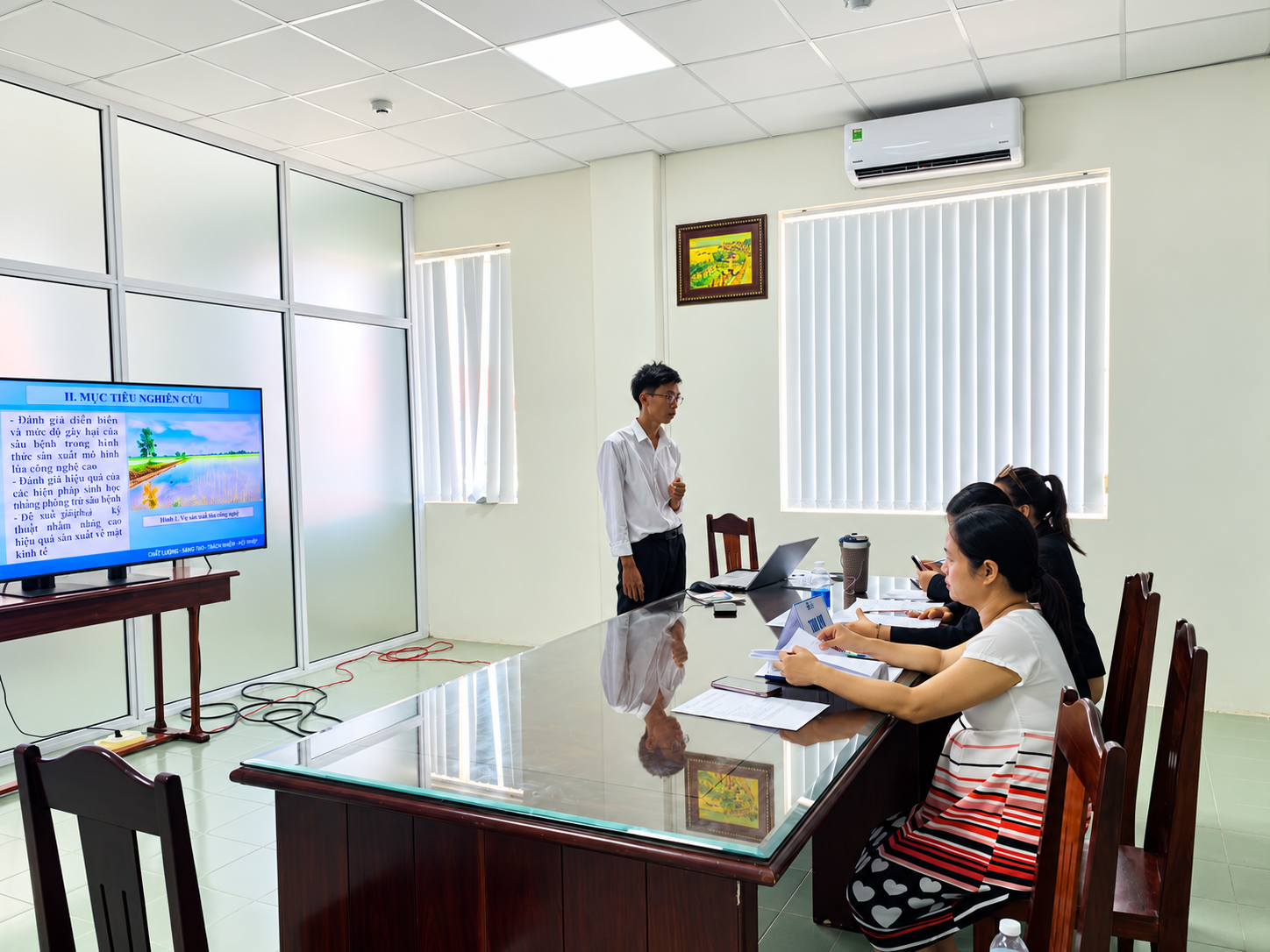
Nguyễn Gia Khiêm presented the research findings to the Evaluation Committee
Notably, the high-technology model reduced the seeding rate and nitrogen fertilizer use and required 20% fewer crop protection applications than the control farming system. The actual rice yield reached 7.56 tonnes/ha, exceeding that of the control fields by 1.53 tonnes/ha; total production costs declined by 2,956,000 VND/ha, while profit increased by 13,666,000 VND/ha. These results demonstrate the potential benefits of integrating technical measures to improve pest and disease management, enhance production efficiency, and reduce adverse impacts on the rice-field environment.
Following the presentation, the Evaluation Committee provided comments and technical feedback on the research methodology, data analysis, pest and disease monitoring results, and the model's applicability under commercial production conditions. The project has practical value because it contributes additional data on the dynamics of rice pests, diseases, and natural enemies and helps guide effective cultivation measures that reduce production costs and strengthen local climate change adaptation.

The Evaluation Committee and Nguyễn Gia Khiêm posed for a commemorative photograph after the research presentation
The final evaluation of student research projects has provided Plant Protection students with an opportunity to strengthen their research capacity, develop skills in data collection and analysis, and apply disciplinary knowledge to practical challenges in agricultural production. The activity further reaffirms the Faculty of Agriculture and Aquaculture at Bac Lieu University's commitment to an educational approach integrated with scientific research, advanced technology transfer, and sustainable agricultural development.
Written by Nguyen Van Bo
Translated by Le My Phuong
